Commercial laundries and textile service operators handle an enormous number of repetitive tasks every day, from collecting soiled items and sorting them by category to washing, drying, repairing, packing, and redistributing clean textiles. In environments such as hotels, hospitals, uniforms services, and hospitality supply chains, those workflows become difficult to manage accurately when identification depends only on visual checks or handwritten records. For that reason, RFID laundry tags continue to attract interest as an efficient solution for textile tracking. Chengdu Mind IOT Technology.,Ltd. says demand remains steady among users who want to reduce linen loss, improve sorting speed, and gain better control over the full lifecycle of reusable textiles.
The main strength of an RFID laundry tag is that it stays with the textile through repeated processing, allowing the item to be identified without interrupting operations. In practical terms, that means a sheet, towel, garment, or uniform can be associated with information such as item type, customer account, usage stage, or service history. Once the textile enters a laundry workflow, staff can scan and count groups of items much faster than they could through manual tally methods. This becomes especially valuable in high-volume operations where even small counting errors can create stock shortages, billing disputes, or internal confusion.
Unlike ordinary labels, laundry tags must endure a demanding environment. Washing, drying, pressing, and repeated handling place heavy stress on any component attached to fabric. Tags therefore need to tolerate moisture, heat, pressure, and mechanical action while remaining securely attached and readable over time. Chengdu Mind IOT Technology.,Ltd. notes that users pay close attention to wash durability because tag failure in the middle of a textile’s service life can interrupt traceability and add replacement work. In many projects, the hidden or sewn-in nature of the tag is just as important as its electronic function, since the product should not interfere with normal use or wearer comfort.
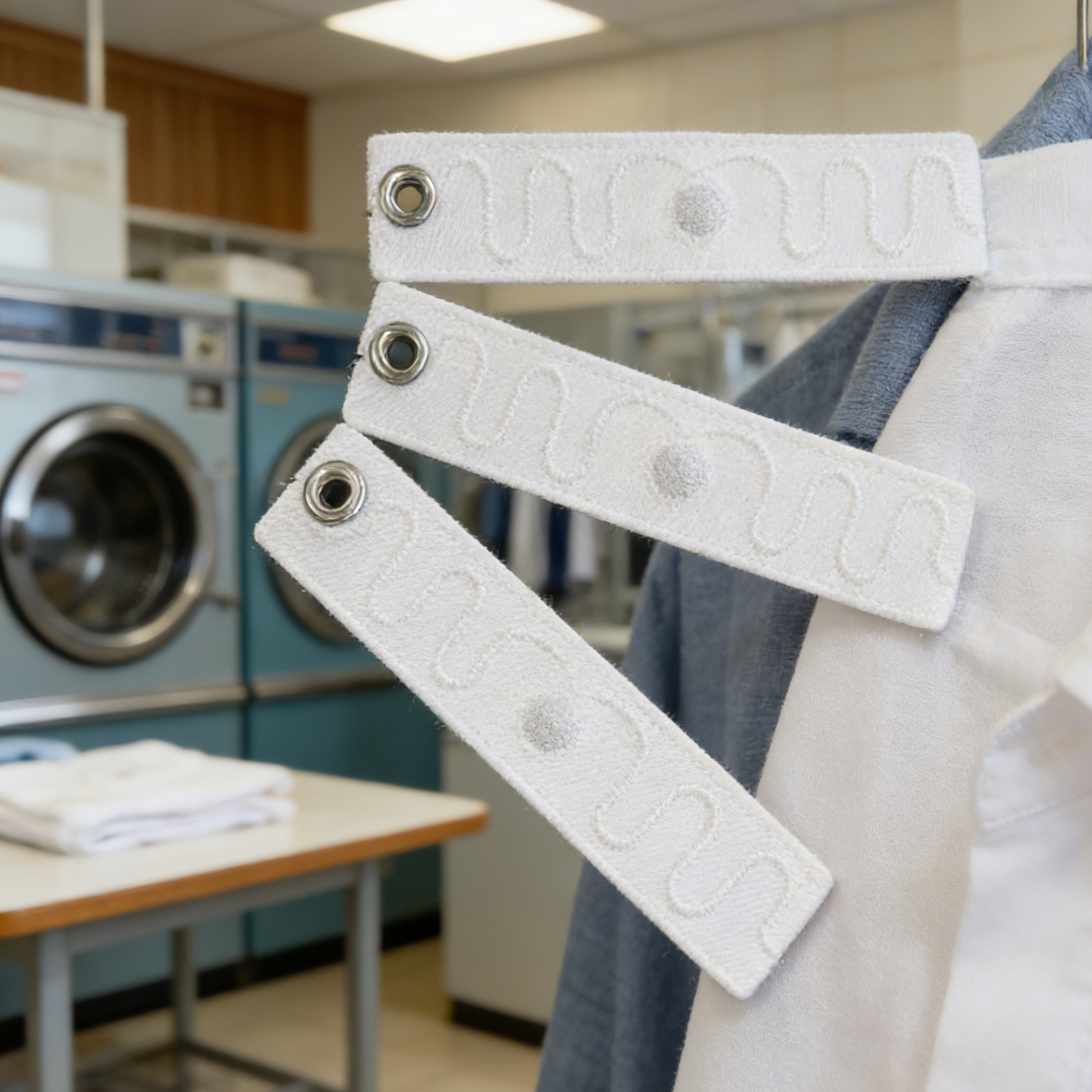
Operationally, RFID can improve several stages of the laundry process. Incoming items can be identified in batches, sorted more accurately, and assigned to the right handling stream. Clean items can then be counted again before packing or return, reducing the risk of under-delivery or over-delivery. Over time, management can build clearer records showing how often certain textiles have circulated, which categories suffer higher loss, and when items are approaching replacement. This helps laundries move from reactive decision-making to more planned inventory control.
Hotels and hospitality users are particularly interested in accountability. Linen is a major operating asset, yet it often disappears gradually through miscounting, internal movement, or damage that is not recorded consistently. Hospitals and uniforms programs face similar concerns, especially when textiles are shared across departments or external processing routes. RFID tagging does not eliminate every source of loss, but it makes it easier to detect discrepancies earlier and create more reliable handling records. That visibility can lead to better stock planning and fewer emergency purchases.
The technology is also supporting service quality. When clean linen supply is managed more accurately, client sites are less likely to experience shortages at critical times. Sorting becomes more organized, and customer-specific handling can be maintained with greater confidence. For laundries serving multiple clients, better identification improves separation between accounts and reduces the chance of mix-ups. Chengdu Mind IOT Technology.,Ltd. says this combination of speed, traceability, and accountability is one of the main reasons textile service operators continue to invest in RFID laundry programs.
As the textile service industry looks for practical ways to improve efficiency without disrupting established processing lines, RFID laundry tags remain one of the clearest examples of applied identification technology. They address everyday operational challenges in a direct way: fewer manual counts, better item visibility, and stronger control over valuable linen and garments. Chengdu Mind IOT Technology.,Ltd. expects interest to continue as more laundries and hospitality users look for tools that support scalable management. In a business built on volume, repetition, and timing, better textile traceability can make a measurable difference.
Post time: Jul-24-2026