In the era of intelligent connectivity, NFC (Near Field Communication) printed sticker tags have become an essential bridge between the physical and digital worlds. Combining the flexibility of printed stickers with the convenience of NFC technology, these passive tags—needing no built-in battery—break the limitations of traditional static labels, which only carry simple information and lack interactivity. As a cost-effective and easy-to-deploy solution, they have been widely applied in various industries and are showing a strong growth momentum, with leading manufacturers like Chengdu Mind IOT Technology Co.,Ltd playing a key role in reshaping information interaction and industrial management modes.
Based on 13.56MHz NFC technology and complying with ISO 14443A protocol, these tags integrate high-precision printing with flexible electronic circuits. They typically feature rewritable storage, long service life, and a “tap-and-interact” function: users only need to bring an NFC-enabled mobile device within a few centimeters to read or write data without cumbersome pairing. Chengdu Mind IOT Technology Co.,Ltd, with rich experience in IoT and RFID production, offers customizable printed surfaces with brand patterns, text or QR codes via advanced printing techniques, and their ultra-thin, flexible design allows the tags to adhere to various materials like paper, plastic and metal, adapting to diverse scenarios.
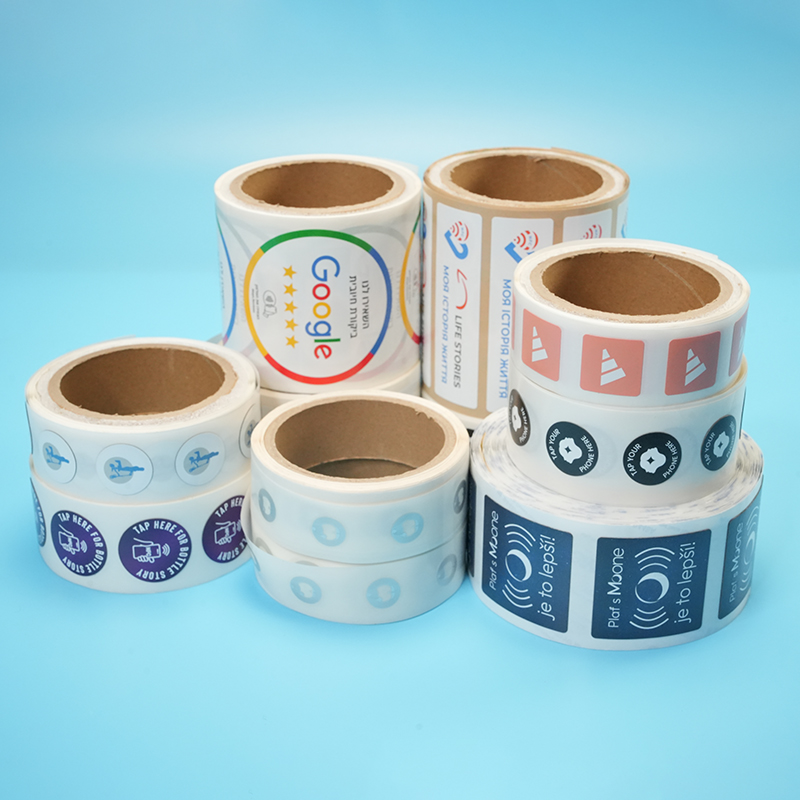
The applications of NFC printed sticker tags are diverse and practical across multiple key industries. In retail, they are attached to product packaging, enabling consumers to access details, origin and reviews with a tap, while helping brands achieve anti-counterfeiting and efficient inventory management. It is predicted that their penetration in retail will reach 35% by 2025. In logistics, they realize full-process traceability of goods, recording location and environmental data to reduce loss, especially for fresh and medical products.
In the medical field, these tags are used on drug packaging and patient wristbands, allowing medical staff to quickly obtain drug information and patient records, improving work efficiency and reducing errors. In the automotive industry, they replace traditional mechanical keys for access control and store maintenance records for after-sales services. They also apply to cultural and creative products, smart home control and membership management, enhancing user experience and brand value.
Driven by market demand and technological progress, NFC printed sticker tags present clear development trends. The global market is expected to grow at a steady compound annual growth rate, with China’s market exceeding 12 billion yuan by 2030 as production costs decline. Technologically, they will develop towards miniaturization and multi-functionality, integrating with AI, 5G and sensors to expand their application boundaries.
Application scenarios will further expand to smart agriculture and industrial manufacturing, combined with cloud platforms for data sharing and intelligent analysis. Meanwhile, market competition will intensify, and industry standardization will be strengthened to ensure product quality and interoperability, with enterprises such as Chengdu Mind IOT Technology Co.,Ltd leading technological innovation and product upgrading. In conclusion, NFC printed sticker tags have broad prospects, driving industrial digital transformation and becoming an indispensable part of the IoT era with continuous innovation from industry leaders.
Post time: May-08-2026