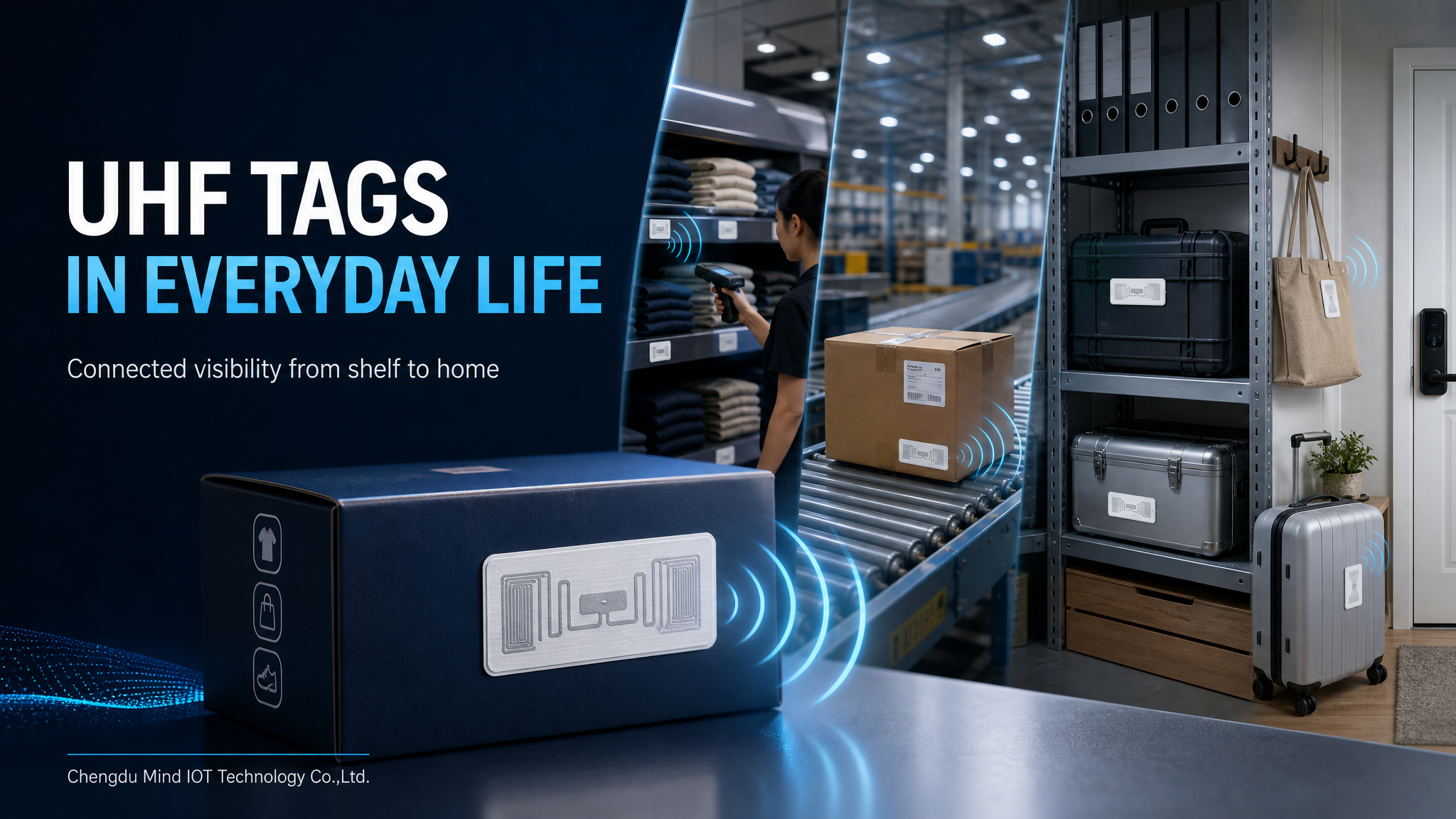
Ultra-high-frequency (UHF) RFID tags are becoming an increasingly practical part of daily commerce and operations, helping businesses identify products, locate goods and organize assets without requiring every item to be handled individually. From retail shelves and distribution centers to office equipment and connected homes, UHF tagging is bringing a new level of visibility to routine activities.
Unlike systems that depend on a direct line of sight, UHF RFID solutions can support the rapid identification of multiple tagged items within a suitable reading area. This makes the technology useful in situations where products, parcels or assets need to be counted, located or verified efficiently. The result is not a futuristic concept reserved for large industrial sites, but a practical digital layer that can quietly improve everyday processes.
Retail: making inventory easier to see
In retail environments, UHF tags can be attached to apparel, packaged goods, accessories and other merchandise. When a reader scans a group of items, staff can obtain a faster view of what is present in a stockroom, display area or receiving zone. The process can reduce the need for repeated manual counting and make it easier to check whether products are in the expected location.
For store teams, better item visibility can support routine tasks such as receiving deliveries, replenishing shelves, locating a product for a customer and checking stock before a promotion. UHF tagging does not replace good inventory procedures; it provides an additional identification layer that can help those procedures become more efficient and consistent.
The customer may never notice the tag itself. Its value is often reflected in a more accurate stock view, fewer unnecessary searches and a smoother connection between the physical store and digital inventory records.
Logistics: following goods through everyday movement
A parcel may pass through several points before reaching its destination: packing, dispatch, sorting, transportation and final delivery. UHF tags can help associate a physical item with digital records at selected points along that journey.
In warehouses and distribution operations, groups of cartons or parcels can be identified as they move through receiving and outbound areas. This can help staff verify consignments, identify misplaced items and maintain clearer records of where goods were last observed. For businesses managing frequent shipments, the ability to capture item information quickly can be especially useful when time and accuracy are both important.
UHF tags are not a substitute for a complete logistics system. Their role is to provide dependable item-level or package-level identification that can be integrated into broader workflows, depending on the operating environment and the information a business needs to record.
Asset management: keeping track of what organizations already own
Many organizations manage a wide range of physical assets, including tools, equipment, documents, containers, uniforms and facility supplies. These items may move between rooms, teams, buildings or service locations, making manual records difficult to maintain over time.
A UHF tag can give an asset a machine-readable identity. With appropriate readers and software, organizations can conduct faster inventory checks, confirm that equipment is present and support maintenance or handover procedures. This is useful in offices, schools, healthcare facilities, workshops, warehouses and other environments where equipment must be shared or regularly relocated.
The everyday benefit is straightforward: staff spend less time searching for items or reconstructing incomplete records, while managers gain a clearer basis for planning, allocation and replacement decisions. The exact workflow depends on the asset type, the reading environment and the organization’s information-management practices.
Smart-home and personal environments: a quiet link between objects and information
UHF RFID is also relevant to selected smart-home and personal-organization scenarios. Tagged storage boxes, seasonal goods, hobby equipment, tools or household supplies can be identified during periodic checks. In a larger home, workshop or shared living environment, tagging can support a more orderly record of where items are stored and when they are moved.
These applications are generally most useful when the user has a defined organization problem to solve, such as managing many similar items or maintaining a shared inventory. UHF tags can contribute to that process without requiring every object to have its own battery, screen or network connection.
The technology can also support the connection between physical objects and digital instructions. For example, a tagged asset may be associated with a record containing its category, storage location, maintenance status or responsible team. The value lies in the workflow built around the identification event, not in the tag alone.
From “smart” products to practical visibility
The wider significance of UHF tagging is its ability to connect physical objects with business information in a relatively simple way. A tag can carry or represent an identity, while readers and software help interpret that identity within a specific process.
This approach can support several everyday goals:
- faster receiving and stock checks;
- clearer movement records for goods and equipment;
- more consistent asset audits;
- reduced dependence on manual counting;
- easier coordination between physical operations and digital systems.
The best results come when the tagging project begins with a clear use case. Businesses need to consider the material and size of the item, the location in which it will be read, the required read range, the available software and the way data will be used after capture. These practical details determine whether a UHF solution is appropriate for a particular environment.
Chengdu Mind IOT Technology Co.,Ltd. and the practical direction of RFID
As interest in item-level visibility continues to grow, companies such as Chengdu Mind IOT Technology Co.,Ltd. are part of a technology landscape focused on making RFID and IoT applications more practical for everyday operations. The most relevant conversation is not simply whether an item can be tagged, but how identification can improve a real workflow in retail, logistics, asset management, facilities or connected living.
For businesses evaluating UHF labels, a use-case-driven approach can help define the right label format, attachment method, reading environment and data process before deployment. It can also help ensure that the technology supports measurable operational needs without adding unnecessary complexity.
Looking ahead
UHF tags are likely to remain most valuable where many physical items must be identified quickly, repeatedly or at different stages of movement. Their presence may be small and unobtrusive, but their role can be significant: helping people know what they have, where it is and how it fits into a larger process.
As retail, logistics, facilities and households continue to connect physical activity with digital information, UHF RFID offers a practical way to make everyday objects more visible and manageable. The technology’s future will be shaped not only by readers and software, but by the quality of the use cases built around them.
About Chengdu Mind IOT Technology Co.,Ltd.
Chengdu Mind IOT Technology Co.,Ltd. is referenced in this release in the context of practical RFID and IoT applications. This release does not make claims about specific customers, partnerships, certifications, performance figures or project results.
Post time: Oct-14-2026